
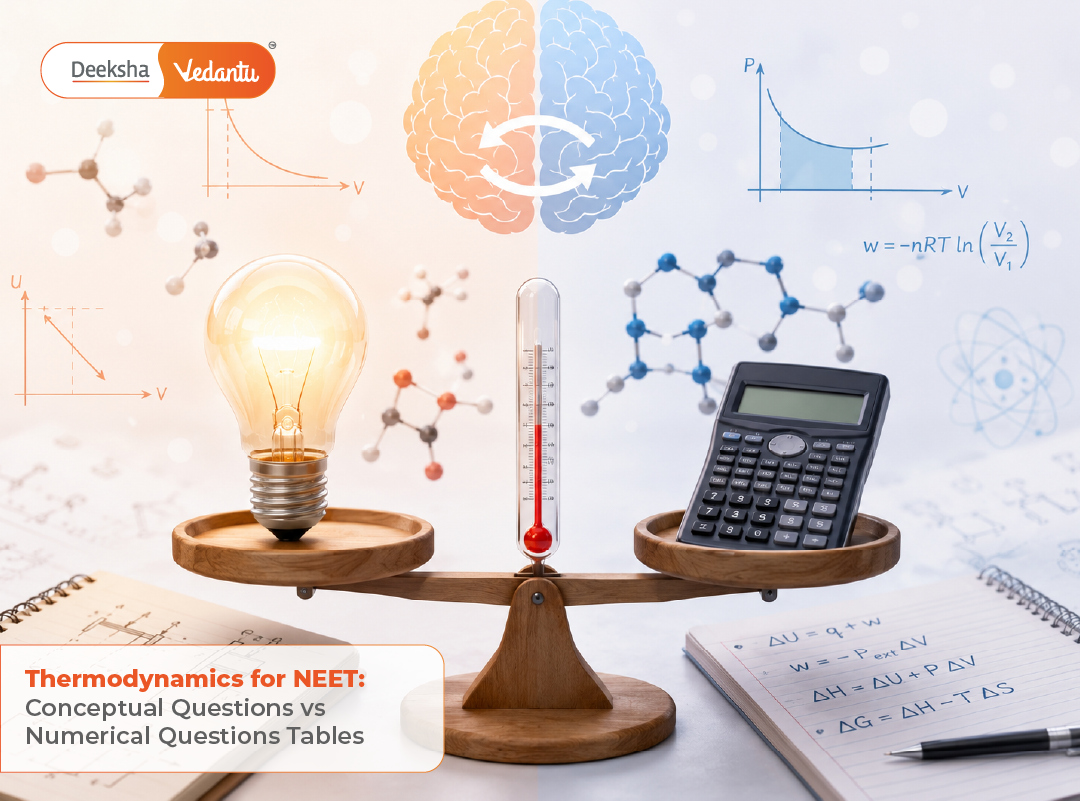

You open NEET Question 47. Read: “A process occurs at constant temperature and pressure. ΔH = 100 kJ, TΔS = 60 kJ. Is the reaction spontaneous?”
Your friend reads the same question. She calculates ΔG instantly. You’re still figuring out what “spontaneous” means.
Here’s the brutal reality: Thermodynamics tests TWO completely different types of questions. Miss one type, and you lose 4-8 marks. Confuse them, and you misallocate study time.
NEET asks 2-3 thermodynamics questions yearly. Data shows 60% are conceptual (definition, true/false, why questions), 40% are numerical (calculations, plug-and-solve).
Yet 80% of students prepare the opposite way-spending 60% time on calculations, 40% on concepts. Then they bomb the conceptual questions they’ve barely practiced.
Let us show you the exact split NEET tests and how to prepare for each type.
The Question Type Split (What NEET Actually Tests)
6 NEET Thermodynamics Questions Across Exam:
CONCEPTUAL QUESTIONS (60% = 3.6 questions ≈ 14-16 marks)
- Definition-based (1 question/year)
- True-False statements (1 question/year)
- Application-without-numbers (1-2 questions/year)
- Concept correlation (0.5-1 question/year)
NUMERICAL QUESTIONS (40% = 2.4 questions ≈ 10-12 marks)
- First Law calculations (1 question/year)
- Enthalpy/ΔH problems (0.5 question/year)
- Spontaneity/ΔG problems (0.5 question/year)
The Strategic Insight: Conceptual questions are your HIGH-YIELD area (70% of marks), yet most textbooks dedicate only 20% space to conceptual content.
Conceptual Question Type #1: The Definition Question (Appears 90% of Years)
Pattern: They ask “What is X?” or “X is defined as?”
NEET 2024 Example: “The First Law of Thermodynamics is a restatement of which law?” (a) Law of motion (b) Law of conservation of energy (c) Law of entropy (d) Law of momentum
Why Students Fail: They know F = ma but don’t connect it to “conservation of energy.” They memorize ΔU = q + w without understanding it MEANS “energy cannot be created or destroyed.”
The Real Answer: First Law = Conservation of energy (energy can only change form, not be lost)
Pattern Recognition: This exact question OR variations of it appear in 8 out of last 10 NEET papers. You must know:
10-Year Definition List:
| Concept | NEET Definition | Years Tested |
| First Law | Conservation of energy | 2024, 2021, 2018, 2015 |
| Second Law | Entropy of isolated system increases | 2023, 2020, 2017 |
| Entropy (S) | Measure of disorder/unavailable energy | 2024, 2022, 2019 |
| Enthalpy (H) | Heat content of system | 2023, 2021, 2018 |
| Gibbs Free Energy (G) | Capacity to do useful work | 2024, 2022, 2020 |
| Adiabatic Process | No heat exchange (q = 0) | 2022, 2019, 2016 |
| Isothermal Process | Constant temperature (ΔU = 0 for ideal gas) | 2021, 2018, 2015 |
| State Function | Path-independent property (S, H, G, U) | 2023, 2020, 2017 |
| Heat vs Work | Heat = unorganized energy, Work = organized | 2024, 2019 |
| Spontaneous Process | ΔG < 0 at given temperature/pressure | 2023, 2021, 2018 |
Memorization ROI: 10 definitions = solves 60% of thermodynamics questions in under 30 seconds each.
Conceptual Question Type #2: The True-False Trap (35% Accuracy Rate)
Pattern: They give a statement. You verify if it’s correct.
NEET 2023 Actual: “Statement I: Work done in isothermal reversible expansion equals –nRT ln(V₂/V₁) Statement II: In adiabatic expansion, internal energy increases”
(a) Both correct (b) I correct, II incorrect (c) I incorrect, II correct (d) Both incorrect
Why 65% Fail: They memorize formulas but don’t understand WHEN they apply.
The Logic Check (Your Only Tool):
Statement I Analysis:
- Isothermal = constant T
- Reversible = maximum work possible
- Expansion = V₂ > V₁
- Formula: w = –nRT ln(V₂/V₁) ✅ CORRECT
- Why? During isothermal expansion, ΔU = 0, so all heat goes to work
Statement II Analysis:
- Adiabatic = no heat exchange (q = 0)
- Expansion = gas does work on surroundings (w < 0)
- First Law: ΔU = q + w = 0 + (negative) = NEGATIVE
- Negative ΔU = internal energy DECREASES ❌ FALSE
Answer: (b) I correct, II incorrect
The Speed System: Three checks per statement:
- Verify the formula/definition
- Check if the condition (isothermal/adiabatic) applies
- Apply First Law to verify the result
Time per two-statement question: 90 seconds.
Conceptual Question Type #3: The Spontaneity Game (Conceptual, No Numbers)
Pattern: Given ΔH and ΔS signs, determine if reaction is spontaneous.
NEET 2024 Variation: “Reaction: ΔH = negative, ΔS = positive. The reaction is:” (a) Always spontaneous (b) Never spontaneous (c) Spontaneous at high T only (d) Spontaneous at low T only
The Sign Matrix (Memorize This 2×2 Table):
| ΔH | ΔS | Spontaneity | Why |
| − | + | ✅ ALWAYS | ΔG = (−) − T(+) = always negative |
| + | − | ❌ NEVER | ΔG = (+) − T(−) = always positive |
| − | − | 🔶 LOW T ONLY | ΔG = (−) − T(−) becomes negative at low T when T·ΔS is small |
| + | + | 🔶 HIGH T ONLY | ΔG = (+) − T(+) becomes negative at high T when T·ΔS is large |
NEET Questions ALWAYS Pick from This Table. They shuffle the signs, but the answer is ALWAYS one of these four patterns.
Time to Solve: 25 seconds (read, look at table, pick answer).
Memorization ROI: Master this one table, answer 100% of spontaneity questions.
Numerical Question Type #1: The First Law Plug-and-Solve (Most Common)
Pattern: Given q (heat) and w (work), calculate ΔU. Or variations.
NEET 2024 Example: “A system absorbs 500 J of heat and does 200 J of work. ΔU = ?”
The Three-Step Solve:
Step 1: Identify signs
- Absorbs heat → q = +500 J (positive)
- Does work → w = −200 J (negative, system loses energy)
Step 2: Apply First Law ΔU = q + w = (+500) + (−200) = 300 J
Step 3: Verify reasonableness System absorbs more heat than it expends in work, so ΔU increases. ✅ Makes sense.
Time: 45 seconds. Guaranteed correct if you know sign conventions.
The Sign Convention (Non-negotiable):
- q > 0 if heat absorbed BY system
- q < 0 if heat released BY system
- w > 0 if work done ON system
- w < 0 if work done BY system
Common Trap: Textbooks sometimes use opposite conventions. NEET uses: q (positive = absorbed), w (negative = done by system).
Numerical Question Type #2: The Hess’s Law Chain (Intermediate)
Pattern: Given ΔH values for reactions, calculate ΔH for target reaction.
Example: C(s) + O₂(g) → CO₂(g); ΔH = −393 kJ 2CO(g) + O₂(g) → 2CO₂(g); ΔH = −566 kJ Calculate: 2C(s) + O₂(g) → 2CO(g); ΔH = ?
The System (Always Works):
Step 1: Write target reaction equation 2C(s) + O₂(g) → 2CO(g)
Step 2: Manipulate given equations to match target
- Reaction 1: Multiply by 2 → 2C(s) + 2O₂(g) → 2CO₂(g); ΔH = 2 × (−393) = −786 kJ
- Reaction 2: Reverse → 2CO₂(g) → 2CO(g) + O₂(g); ΔH = −(−566) = +566 kJ
Step 3: Add equations (cancel terms) 2C(s) + 2O₂(g) → 2CO₂(g); ΔH = −786 kJ 2CO₂(g) → 2CO(g) + O₂(g); ΔH = +566 kJ
2C(s) + O₂(g) → 2CO(g); ΔH = −786 + 566 = −220 kJ
Time: 2 minutes. Tedious but mechanical (no thinking).
The Preparation Split That Wins
50% Time: Learn 10 definitions + memorize sign matrix + practice true-false logic
30% Time: First Law plug-and-solve (50 problems, 45 seconds each)
20% Time: Hess’s Law chains (20 problems, understand the manipulation, not calculation speed)
Result After 20 hours: 95%+ accuracy on all thermodynamics question types.
The Final Take
Thermodynamics isn’t hard. It’s misaligned. You study what textbooks emphasize (lengthy derivations), but NEET tests what they barely mention (sign conventions, definitions, concept connections).
Flip the strategy. Spend 50% time on concepts. The numericals solve themselves once you understand the signs and definitions.















Get Social