
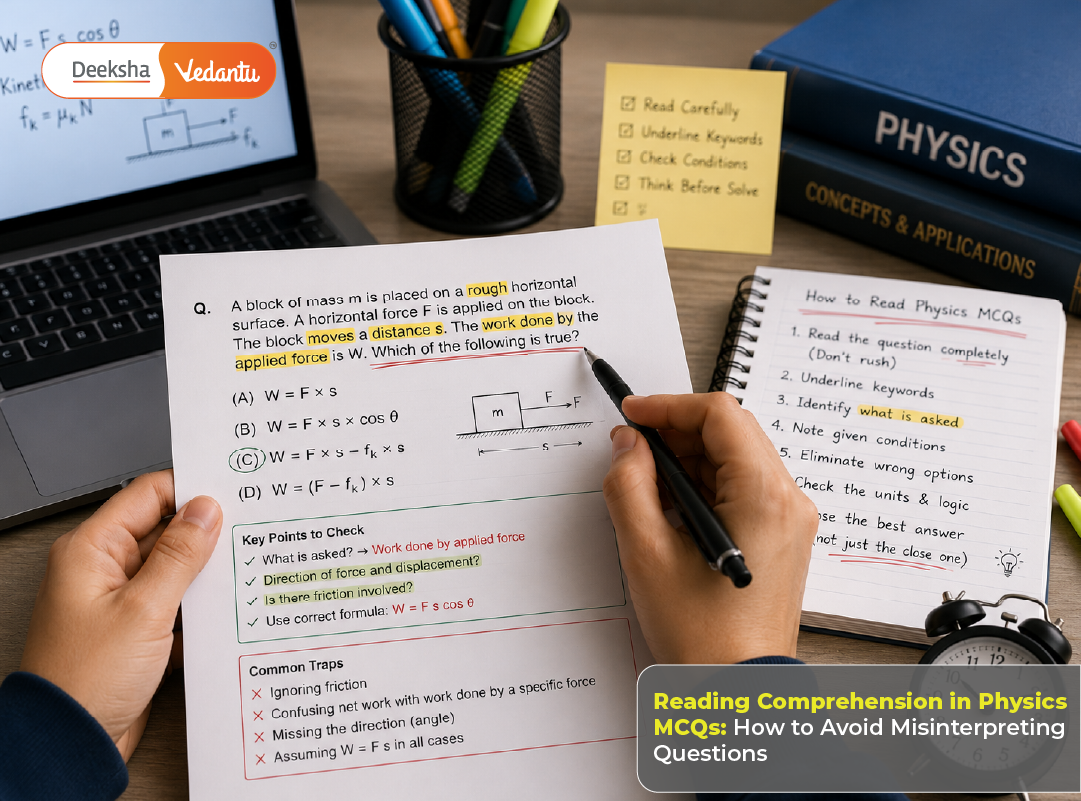

You solve a physics MCQ correctly. You get the wrong answer. You read the question again. You realize: You calculated the velocity when it asked for acceleration.
This happens constantly in NEET physics. Not because you don’t know physics. Because you misread the question.
Here’s how to stop doing that.
Why Physics MCQs Are Easy to Misread
Physics questions are deceptively tricky. They use language precisely. One word changes everything.
Example:
- “Calculate the acceleration” vs “Calculate the deceleration”
- “What is the velocity at 5 seconds?” vs “What is the velocity after 5 seconds?”
- “A block sliding down a frictionless incline” vs “A block sliding down an incline”
Each word matters. Missing one word means wrong calculation.
Real Misinterpretation Examples (From NEET Papers)
Misread #1: Confusing “On” with “From”
Question: “An object is thrown vertically upward from the ground. What is its velocity on returning to ground?”
❌ Misread version: “What is its velocity at the top?”
- You calculate the velocity at maximum height (which is 0)
- Wrong answer
✅ Correct reading: “On returning to ground” = when it comes back down
- Use energy conservation or kinematics
- Velocity magnitude equals initial velocity (but opposite direction)
Why this happens: Your brain reads “returning to ground” too quickly and assumes “at top.”
Misread #2: Missing the Negative Sign Instruction
Question: “A particle moves with acceleration a = -2t. If initial velocity is 5 m/s, find velocity at t = 2s.”
❌ Misread approach: You see “a = -2t” and treat it as a = 2t
- Calculated v = 5 + 2(2) = 9 m/s
- Wrong
✅ Correct approach: a = -2t means acceleration is negative and increases in magnitude
- v = 5 + ∫(-2t)dt from 0 to 2
- v = 5 – 4 = 1 m/s
Why this happens: The negative sign looks like punctuation. You skip it.
Misread #3: Unit Confusion in the Question
Question: “A car accelerates at 2 m/s² for 0.5 minutes. What distance does it travel?”
❌ Misread version: You use t = 0.5 seconds
- s = ½(2)(0.5)² = 0.25 m
- Wildly wrong
✅ Correct reading: 0.5 minutes = 30 seconds
- s = ½(2)(30)² = 900 m
Why this happens: You see “0.5” and skip converting minutes to seconds.
Misread #4: “Initially at Rest” vs “Initially Moving”
Question: “A ball is released from rest at height h. Ignoring air resistance, find velocity when it hits ground.”
❌ Misread version: You think “released” means thrown upward first
- You calculate extra height from initial velocity
- Wrong
✅ Correct reading: “Released from rest” = starting from zero velocity, just falling
- v = √(2gh)
Why this happens: “Released” and “thrown” sound similar. You confuse them.
The 4-Step Question Reading Protocol
Use this BEFORE doing any calculation:
Step 1: Identify What’s Given (Underline It) Read the question. Physically underline every number, unit, and condition.
Example: “A block slides down a frictionless incline of 30° for 5 seconds. What is the displacement?”
What you identified: frictionless (no friction), 30°, 5 seconds, displacement
Step 2: Identify What’s Asked (Highlight It) Read the question’s ending. Highlight the exact question.
Example: “What is the displacement?” (NOT acceleration, NOT velocity, NOT time)
Step 3: Check for Trap Words Physics questions use precise language. Watch for:
- “At” vs “After” (position at 5s vs position after 5s travel)
- “When” vs “While” (at the moment vs during the period)
- “Maximum” vs “Initial” (highest point vs starting point)
- “Finally” vs “Briefly” (end state vs momentary state)
Step 4: Reread the Question Backwards Start from the answer options and read back to the question.
This forces your brain to reprocess and catch misreadings.
The Common Trap Words in Physics
| Trap Word | What Students Miss | Consequence |
| “Initial” | Confuse with “final” | Wrong starting conditions |
| “On” | Miss location/timing nuance | Wrong reference point |
| “Through” | Confuse with “at” | Wrong distance |
| “Neglect” | Don’t notice what to ignore | Include wrong variable |
| “Just” (as in “just as it leaves”) | Treat as “right after” | Timing error |
| “Relative to” | Forget reference frame | Wrong direction |
The Pre-Calculation Checklist
Before you write a single equation:
☐ Have I underlined all given data?
☐ Have I highlighted what’s being asked?
☐ Is this asking for magnitude or vector (with direction)?
☐ Is this initial state, final state, or change?
☐ Are all units consistent (SI units)?
☐ Did I identify trap words?
☐ Could any word mean something else in physics?
This takes 30 seconds. It prevents wrong answers that cost 4 marks.
Real Exam Strategy
During NEET physics:
First read (1 minute per question):
- Read slowly
- Underline given data
- Highlight the question
- Reread the last sentence
Then calculate (1-2 minutes):
- Now you calculate
- You’re calculating the RIGHT thing
Most students skip the first read. That’s why they get wrong answers despite knowing physics.
Physics MCQ misinterpretation isn’t a knowledge problem. It’s a reading problem. Use the 4-step protocol: Identify given, Identify asked, Check trap words, Reread backward. This single habit prevents 5-10 mark losses in NEET physics.















Get Social