

Picture this: NEET Biology paper, Question 8 appears-“Which group shows dominant gametophyte phase?” You freeze. Was that Bryophyta or Pteridophyta? You studied Plant Kingdom twice but the classifications blur together.
Here’s the brutal truth: Plant Kingdom contributes 2-3 questions (8-12 marks) every NEET. Most students lose these marks not because the chapter is hard, but because they memorize five groups separately instead of comparing them systematically.
The secret? Side-by-side comparison tables that show differences at a glance. Once you see Bryophyta and Pteridophyta compared directly, you’ll never confuse them again.
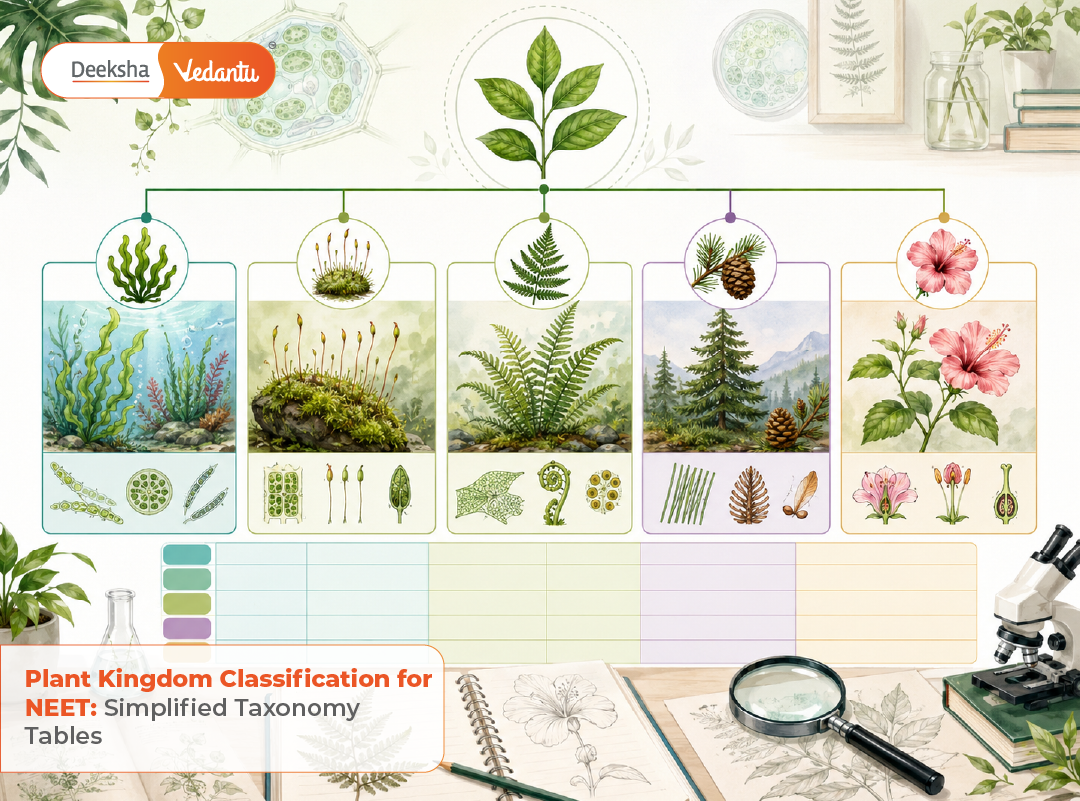
The Master Classification Tree
PLANT KINGDOM (Plantae)
│
├─── CRYPTOGAMS (Hidden reproduction – spores)
│ │
│ ├── Algae (Thallophyta)
│ ├── Bryophyta
│ └── Pteridophyta
│
└─── PHANEROGAMS (Visible reproduction – seeds)
│
├── Gymnosperms (Naked seeds)
└── Angiosperms (Covered seeds)
├── Monocots
└── Dicots
Memory Hook: CRYPTOGAMS hide their babies (spores), PHANEROGAMS show them off (seeds).
The Evolution Ladder (Simple > Complex)
| Feature | Algae | Bryophyta | Pteridophyta | Gymnosperms | Angiosperms |
| Body | Thallus | Leafy gametophyte | Root-stem-leaf | Root-stem-leaf | Root-stem-leaf |
| Vascular Tissue | ❌ Absent | ❌ Absent | ✅ Present | ✅ Present | ✅ Present |
| Seeds | ❌ No | ❌ No | ❌ No | ✅ Naked | ✅ Covered |
| Flowers | ❌ No | ❌ No | ❌ No | ❌ No | ✅ Yes |
| Habitat | 💧 Aquatic | 🌍 Amphibious | 🌍 Terrestrial | 🌍 Terrestrial | 🌍 Terrestrial |
The Pattern: Each step adds one new feature. Algae > add land survival = Bryophyta. Bryophyta > add vascular tissue = Pteridophyta. Pteridophyta > add seeds = Gymnosperms. Gymnosperms > add flowers = Angiosperms.
NEET loves asking: “First group with vascular tissue?” > Pteridophyta. “First group with seeds?” > Gymnosperms.
Algae: The Three Color Codes
NEET doesn’t ask about all algae-just three types based on pigments.
🟢 CHLOROPHYCEAE (Green Algae)
| Feature | Details |
| Color | Grass green (chlorophyll a & b dominant) |
| Cell Wall | Cellulose (inner) + Pectose (outer) |
| Stored Food | Starch |
| Flagella | 2-8, equal length |
| Examples | Chlamydomonas, Volvox, Ulothrix, Spirogyra |
| NEET Pattern | “Which algae has pyrenoids?” > Green algae |
🟤 PHAEOPHYCEAE (Brown Algae)
| Feature | Details |
| Color | Brown (fucoxanthin pigment masks chlorophyll) |
| Cell Wall | Cellulose + Algin |
| Stored Food | Laminarin, Mannitol |
| Flagella | 2, unequal (one forward, one backward) |
| Examples | Ectocarpus, Dictyota, Laminaria, Sargassum, Fucus |
| NEET Pattern | “Largest marine algae?” > Brown algae (kelps) |
🔴 RHODOPHYCEAE (Red Algae)
| Feature | Details |
| Color | Red (r-phycoerythrin pigment) |
| Cell Wall | Cellulose + Polysulphate esters |
| Stored Food | Floridean starch |
| Flagella | ❌ Absent (unique among algae) |
| Examples | Polysiphonia, Porphyra, Gracilaria, Gelidium |
| NEET Pattern | “Non-motile algae?” > Red algae |
Quick Recall Trick:
- GREEN = Common freshwater (Spirogyra in ponds)
- BROWN = Big marine plants (Sargassum Sea named after it)
- RED = Deep ocean (red light penetrates deepest)
Bryophyta vs Pteridophyta: The Confusion Ender
NEET’s favorite comparison. Memorize this table, never confuse again.
| Characteristic | BRYOPHYTA | PTERIDOPHYTA |
| Common Name | “Amphibians of Plant Kingdom” | “Vascular Cryptogams” |
| Why the Name? | Need water for reproduction (like frogs) | Have vascular tissue but no seeds |
| Dominant Phase | GAMETOPHYTE (haploid) | SPOROPHYTE (diploid) |
| Plant Body | Leafy, stem-like, rhizoids (not true roots) | True roots, stems, leaves |
| Vascular Tissue | ❌ Absent (xylem/phloem missing) | ✅ Present (first group to have it) |
| Water Requirement | External water for fertilization (sperm swims) | External water for fertilization |
| Examples | Riccia, Marchantia (liverworts); Funaria, Sphagnum (mosses) | Selaginella, Lycopodium, Equisetum, Pteris (ferns) |
| Economic Use | Peat formation (fuel), Sphagnum (packaging) | Ornamental (ferns), some medicinal |
NEET Gold Questions:
Q: “Which group is called amphibians of plant kingdom?” A: Bryophyta (needs water like amphibians)
Q: “First terrestrial plants with vascular tissue?” A: Pteridophyta
Q: “Dominant gametophyte phase is found in?” A: Bryophyta (this is THE distinction from Pteridophyta)
Gymnosperms vs Angiosperms: The Seed Showdown
Both produce seeds, but presentation differs.
| Feature | GYMNOSPERMS | ANGIOSPERMS |
| Meaning | Gymnos = Naked, Sperma = Seed | Angio = Covered, Sperma = Seed |
| Seeds | Naked (on cone scales) | Inside fruit (ovary develops into fruit) |
| Flowers | ❌ Absent (only cones) | ✅ Present (colorful, petals) |
| Pollination | Mostly wind | Wind, insects, animals, water |
| Fertilization | Single fertilization | Double fertilization (unique) |
| Xylem | Tracheids only | Vessels (more efficient) |
| Phloem | No companion cells | Companion cells present |
| Examples | Cycas, Pinus, Cedrus, Ginkgo | Rice, wheat, mango, rose (90% of plants) |
| Lifecycle | Perennial (live many years) | Annual/perennial both |
NEET Pattern Questions:
Q: “Plants with naked seeds?” A: Gymnosperms
Q: “Double fertilization occurs in?” A: Angiosperms only (one sperm > egg, other > polar nuclei)
Q: “Most advanced plant group?” A: Angiosperms (have all features: vascular tissue, seeds, flowers, fruits)
Monocots vs Dicots: The Final Split
Within Angiosperms, this distinction appears 1-2 times yearly.
| Feature | MONOCOTS | DICOTS |
| Cotyledons | 1 (mono = one) | 2 (di = two) |
| Root System | Fibrous (many thin roots) | Tap root (one main root) |
| Leaf Venation | Parallel | Reticulate (net-like) |
| Flower Parts | Multiples of 3 (3, 6, 9 petals) | Multiples of 4 or 5 |
| Vascular Bundles | Scattered in stem | Ring arrangement |
| Secondary Growth | ❌ Absent | ✅ Present (become woody) |
| Examples | Wheat, rice, maize, banana, palm, lily, onion | Pea, mango, rose, sunflower, mustard |
Visual Memory Trick:
MONOCOT LEAF: |||||| (parallel lines like ruled paper) DICOT LEAF: 🕸️ (spiderweb pattern)
The Dominant Phase Concept (High-Frequency)
NEET tests this repeatedly. Understand once, remember forever.
Two Phases in Plant Life Cycle:
- Gametophyte (n): Haploid, produces gametes (sex cells)
- Sporophyte (2n): Diploid, produces spores
Dominance Pattern:
| Group | Dominant Phase | What You See |
| Algae | Haploid/Diploid (varies) | Depends on species |
| Bryophyta | GAMETOPHYTE | Green leafy plant is haploid |
| Pteridophyta | SPOROPHYTE | Fern plant is diploid |
| Gymnosperms | SPOROPHYTE | Tree is diploid |
| Angiosperms | SPOROPHYTE | Flowering plant is diploid |
The Shift: Bryophyta > Pteridophyta is where dominance shifts from gametophyte to sporophyte. Evolution favored diploid dominance (more genetic variation).
NEET Question Pattern: “In which group is gametophyte dominant and independent?” > Bryophyta
Economic Importance Quick Table
NEET occasionally asks “What is X used for?”
| Group | Species | Use |
| Algae | Chlorella, Spirulina | Protein-rich food (SCP) |
| Algae | Gelidium, Gracilaria | Agar production |
| Algae | Laminaria | Iodine source |
| Bryophyta | Sphagnum | Packing material (absorbs water) |
| Bryophyta | Peat | Fuel |
| Pteridophyta | Pteris, Adiantum | Ornamental (ferns) |
| Gymnosperms | Pinus | Timber, resin, turpentine |
| Gymnosperms | Cycas | Sago (starch) |
| Angiosperms | Rice, Wheat | Staple food (90% human diet) |
The Alternation of Generations Cheat Sheet
This concept confuses students. Here’s the simple version:
What Happens: Plants alternate between diploid (2n) and haploid (n) stages in their life cycle.
The Cycle: Sporophyte (2n) > Meiosis > Spores (n) > Gametophyte (n) > Gametes (n) > Fertilization > Zygote (2n) > Sporophyte (2n)
Which Phase is Dominant?
- Bryophyta: You see the gametophyte (green moss). Sporophyte is tiny, dependent.
- Pteridophyta onwards: You see the sporophyte (fern plant). Gametophyte is tiny, independent/dependent.
NEET doesn’t ask for the full cycle. They ask: “Which is dominant?” Know that, and you’re set.
The 48-Hour Before Exam Checklist
✅ Can you differentiate all five groups in one sentence each?
✅ Do you know the three algae types by color?
✅ Can you state THE difference between Bryophyta and Pteridophyta?
✅ Do you know which group first had vascular tissue? Seeds? Flowers?
✅ Can you list 2 examples for each of the 5 main groups?
✅ Do you know monocot vs dicot in 4 features?
If yes to all > targeting 8-10/12 marks from Plant Kingdom.
The Final Check
Plant Kingdom isn’t about memorizing 100 plant names. It’s about understanding 5 groups through 4 key differentiators: body type, vascular tissue, reproduction method, dominant phase. Master the comparison tables, and every question becomes a 40-second pattern match.
The students scoring full marks aren’t studying harder-they’re studying smarter with comparison-based tables instead of isolated chapter reading.


















Get Social