
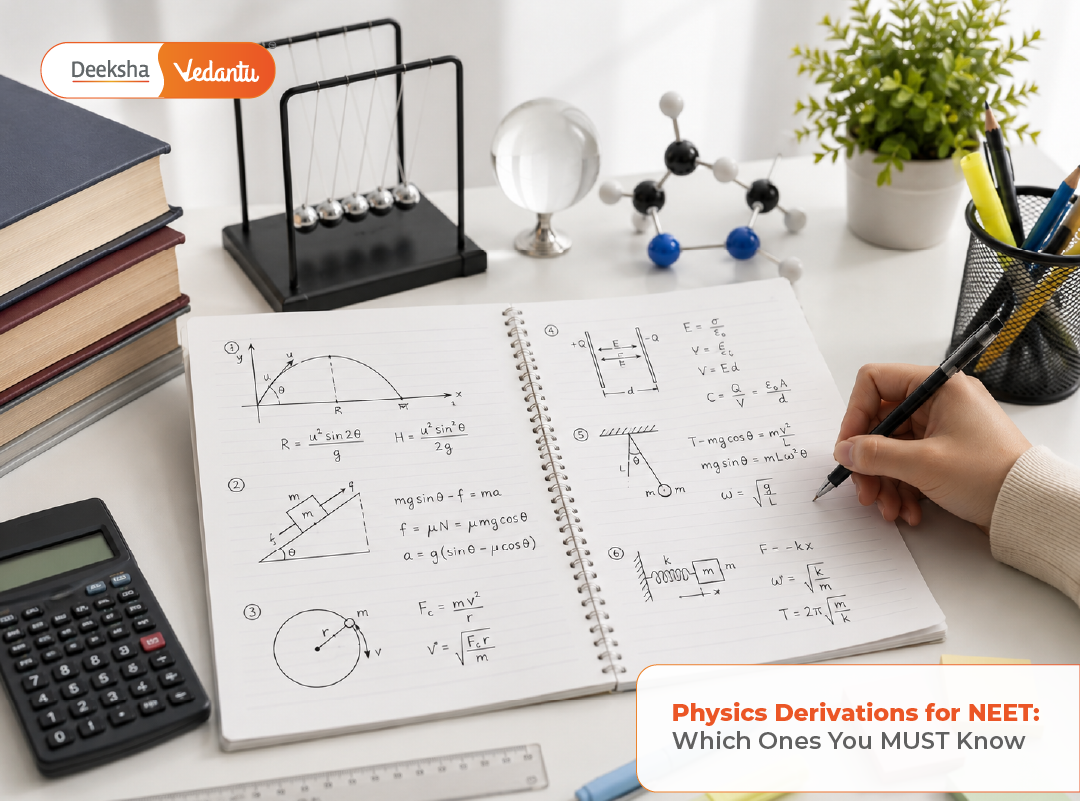

Let’s address the elephant in the exam hall: NEET doesn’t directly ask “Derive the expression for kinetic energy.” So why are students spending 40 hours deriving 30 formulas when NEET tests application, not derivation?
Here’s the paradox-derivations aren’t tested directly, but students who know them score 15-20 marks higher. Why? Because derivations reveal the CONDITIONS under which formulas work. When you know v² = u² + 2as comes from integrating a = dv/dt, you know it ONLY works for constant acceleration. Miss this, and you’ll use it on variable acceleration questions and lose 4 marks.
The strategy isn’t “memorize all derivations.” It’s “know the 12 derivations that unlock formula application.”
The Three-Tier System
Tier 1: Must Know (Practice Until You Can Derive in Sleep)
These aren’t just formulas-they’re conceptual frameworks. Questions testing these appear 8-12 times yearly across mechanics, electricity, and optics.
- Equations of Motion (v = u + at, s = ut + ½at², v² = u² + 2as)
Why it matters: Solves 6-8 kinematics questions directly. But more importantly, NEET loves asking “when does this NOT apply?” Answer: Variable acceleration, circular motion, projectile vertical component.
The derivation: Integration from a = dv/dt and v = ds/dt. Takes 3 minutes. Unlocks 24-32 marks across mechanics.
- Kinetic Energy (KE = ½mv²)
Why it matters: Appears in work-energy, collision, and rotational motion questions. The derivation from Work = ∫F·ds reveals why kinetic energy is SCALAR despite velocity being vector.
NEET trap: “A ball moves in circle at constant speed. Change in KE?” Students who memorized “KE = ½mv²” say zero. Students who derived it know speed constant → KE unchanged (correct). Derivation saves 4 marks.
- Escape Velocity (v_e = √(2GM/R))
Why it matters: Direct question 1-2 times yearly. But the derivation from energy conservation (½mv² = GMm/R) shows you why it’s INDEPENDENT of mass-a concept question that repeats.
- Time Period of Simple Pendulum (T = 2π√(l/g))
Why it matters: The derivation from F = -mgsinθ ≈ -mgθ reveals the small angle approximation. NEET asks: “For large angles, will the period increase or decrease?” Derivation-knowers ace it.
- Lens Formula (1/f = 1/v – 1/u)
Why it matters: Ray optics gives 3-4 questions. The derivation from similar triangles in ray diagrams shows why u is negative (sign convention)-the most commonly tested confusion point.
- Drift Velocity (I = neAvd)
Why it matters: Current electricity yields 2-3 questions. Derivation connects microscopic (electron motion) to macroscopic (current)-exactly how NEET frames conceptual questions.
Tier 2: Should Know (Revise 2-3 Times)
These appear less frequently but unlock entire chapters when understood.
- Bernoulli’s Equation (P + ½ρv² + ρgh = constant)
Application: Fluid mechanics questions about varying pipe diameter or height. Derivation from work-energy theorem for fluids shows when it fails (viscous fluids, turbulent flow).
- Transformer Equations (Vs/Vp = Ns/Np = Ip/Is)
Application: Electromagnetic induction 1-2 questions. Derivation from flux conservation reveals ideal transformer assumption-often the trap.
- Photoelectric Effect (KEmax = hf – φ)
Application: Modern physics 2-3 questions. Einstein’s derivation shows why intensity doesn’t affect KE-a repeated concept question.
- de Broglie Wavelength (λ = h/p)
Application: Dual nature questions. Derivation from E = hf and E² = (pc)² + (mc²)² connects wave and particle nature-exactly what NEET tests conceptually.
Tier 3: Good to Know (Read Once, Don’t Practice)
These rarely appear, but reading once prevents panic if they do.
- Capacitance of Parallel Plate Capacitor (C = ε₀A/d) 12. Radioactive Decay (N = N₀e^(-λt))
Read derivations once from NCERT. If they appear, you’ll recall the approach. Don’t waste time practicing these.
The Strategic Approach
Week 1-2: Practice Tier 1 derivations daily. Write them from memory without referring notes. Time yourself-each should take 3-5 minutes maximum.
Week 3: Add Tier 2. Practice alternate days. Focus on understanding steps, not memorizing.
Week 4 onwards: Weekly revision of all 10. Spend 30 minutes total.
Before exam: Can you derive the Tier 1 list in 20 minutes total? If yes, you’re ready.
The Application Test
Knowing derivation ≠ scoring marks. The real test: Can you identify WHEN to use the formula?
Example Question: “A car accelerates then brakes. Distance covered in 10 seconds?”
Memorizer thinks: Use s = ut + ½at²
Derivation-knower thinks: Wait-acceleration isn’t constant (accel → brake). This formula doesn’t apply. Need to split the journey into two parts.
That’s a 4-mark save from understanding one derivation’s assumption.
Deeksha’s Derivation Mastery
At Deeksha Learning, we don’t teach 30 derivations. We teach 12 that matter, with emphasis on assumptions and failure conditions. Our Physics module includes derivation practice sheets, application-based PYQs mapped to each derivation, and weekly derivation speed tests.
Master derivations strategically, not exhaustively.
The Bottom Line
NEET doesn’t test derivations. It tests understanding. Derivations are the path to understanding. Know the 12 that unlock application, skip the rest. That’s the difference between 130 and 150 in Physics.

















Get Social