
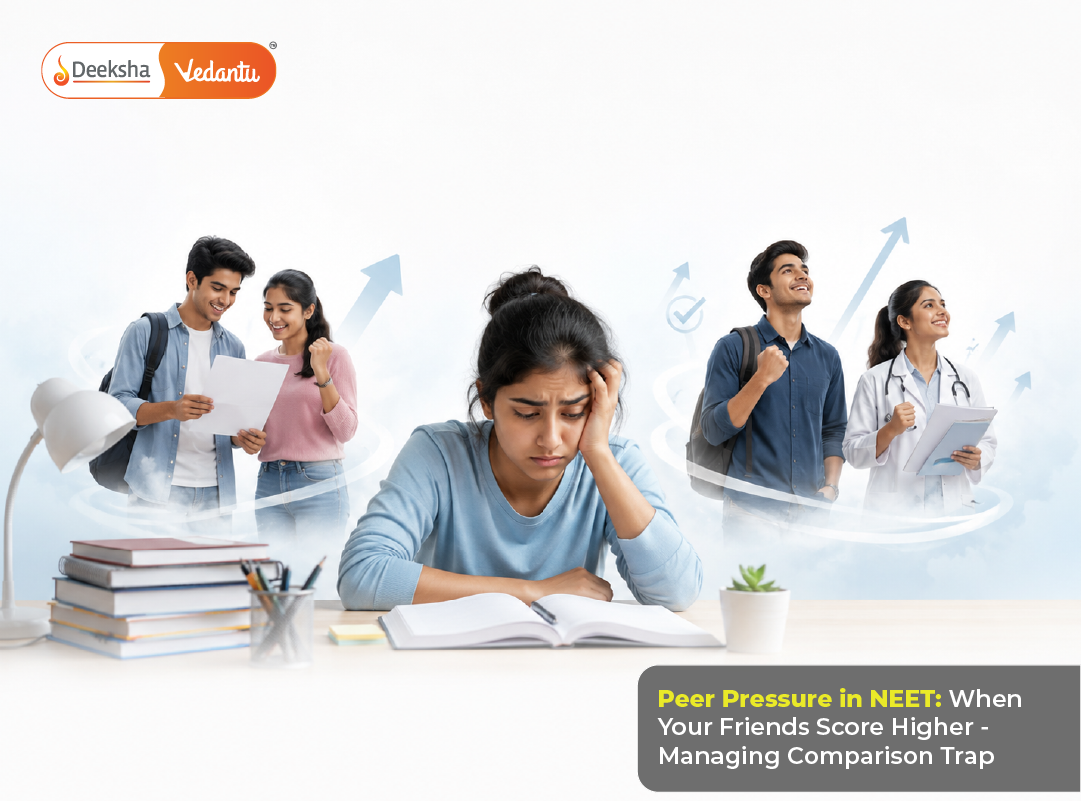

Your friend scores 650. You score 580. The instant you find out, something shifts.
It’s not envy. It’s not jealousy alone. It’s your brain doing something automatic that you don’t control.
Here’s what’s actually happening-and how to stop it.
The Comparison Machine: How Your Brain Works (Neuroscience)
Your brain is a comparison machine. It doesn’t do this on purpose. It’s hardwired.
Festinger’s social comparison theory shows that people unconsciously compare themselves to others constantly, especially to those around them, to determine their own worth.
Here’s the automatic sequence:
Step 1: Pattern Recognition (Automatic) You hear your friend scored 650. Your brain instantly extracts: 650 > 580.
This happens in 200 milliseconds. You don’t choose it.
Step 2: Relative Deprivation (Automatic) Your brain interprets: “They have something I don’t.”
Not just a score difference. Your brain codes it as: “They’re ahead. I’m behind.”
Step 3: Rumination (Semi-Automatic) Your brain starts the loop:
- “Why did they score higher?”
- “What did they do that I didn’t?”
- “Does this mean they’re smarter?”
- “Will they get a better college?”
- “Will they have a better career?”
This happens without you deciding to think about it.
Step 4: Anxiety (The Outcome) Upward social comparison-comparing yourself to those better than you-increases anxiety and negative self-evaluation.
Your score hasn’t changed. Your capability hasn’t changed. But your anxiety just did.
Why Your Friend’s Score Feels Like Your Failure
The comparison trap isn’t about logic. It’s about how your brain frames scarcity.
Your brain’s assumption: “There are X medical college seats. My friend took one. That means fewer for me.”
Reality: Medical colleges have thousands of seats. Your friend’s success doesn’t reduce your chances.
But your brain doesn’t think in facts. It thinks in zero-sum games.
In competitive environments with limited resources, upward comparison feels like a threat-you magnify your own shortcomings and evaluate yourself more negatively.
The Three Types of Comparison You’re Running
Upward Comparison: “They’re Better”
Your friend scored 650, you scored 580.
This is upward comparison. Your brain puts them above you on a hierarchy.
Effect: Anxiety, shame, low self-esteem
How it feels: “They’re smarter, they’ll get a better college, they’ll have a better life”
The trap: This comparison feels productive (“I’ll try harder”) but actually reduces motivation (gives up feeling).
Lateral Comparison: “We’re Equal”
You and your friend both scored 600. They got physics right, you got chemistry right.
This is lateral comparison. You’re on the same level but different paths.
Effect: Moderate anxiety (not as bad as upward)
How it feels: “We’re similar, but they chose better topics”
The benefit: Lateral comparison can be motivating IF you reframe it as “what did they do that I can copy?” instead of “they won, I lost.”
Downward Comparison: “I’m Better”
You scored 600, your friend scored 500.
This is downward comparison. You’re ahead.
Effect: Temporary relief (“at least I’m doing better”)
The trap: Downward comparison feels good, but it’s fragile. As soon as someone scores higher, you crash.
Why Social Media Destroys NEET Comparison
On WhatsApp group: “Got 650! 🎉”
Your brain sees:
- Their score (650)
- The celebration emoji (they’re happy)
- The public announcement (everyone knows)
- The timing (right after you checked your 580)
What you don’t see:
- How many times they failed practice tests
- Their anxiety the night before exam
- That they got lucky on 5 questions
- That they might retake (not mentioned)
Social media creates continuous opportunities for achievement-focused comparisons, which increases anxiety and reduces wellbeing when comparisons favor others.
You’re comparing your complete internal reality (struggles, doubts, failures) to their curated external moment (success).
That’s not a fair comparison. Your brain doesn’t care.
The Comparison Rewrite That Actually Works
You can’t stop the automatic comparison. But you can rewrite what it means.
The Original Script (Automatic): Friend scores 650 > Brain: “They’re better” > You: “I’m not good enough” > Anxiety
The Rewrite (Chosen): Friend scores 650 > Brain: “They’re better at test-taking right now” > You: “What can I learn from how they prepared?” > Motivation
Notice the difference: Same fact (they scored 650). Different meaning.
Three Practical Rewrites
Rewrite 1: Separate Person from Performance
❌ Original: “They scored 650, so they’re smarter than me”
✅ Rewrite: “They scored 650 on this test. I scored 580. Neither score defines intelligence.”
Intelligence is too complex to measure by one exam. You might be better at understanding concepts, worse at managing test anxiety. That’s not smarter/dumber. That’s different.
Rewrite 2: Extract the Data, Ignore the Hierarchy
❌ Original: “They beat me”
✅ Rewrite: “They scored 70 marks higher. What 3 chapters did they focus on that I didn’t? Can I learn that?”
Turn comparison into information. “What did they do?” is useful. “Are they better?” is not.
Rewrite 3: Remember Your Different Starting Point
You and your friend have different:
- Study hours (different schedules)
- Concept gaps (different weak areas)
- Test anxiety (different psychological states)
- Luck (different question distributions)
Your friend’s score isn’t proof you’re inferior. It’s proof they had a different combination of factors.
The Self-Efficacy Antidote
Students with high self-efficacy view academically successful peers as benchmarks for improvement, not threats. They perceive excellent peer performance as motivation rather than failure.
The difference isn’t intelligence. It’s self-efficacy-believing you can improve.
Low self-efficacy: “They scored higher, so I can’t” High self-efficacy: “They scored higher, so I can learn how”
This isn’t toxic positivity. It’s a different interpretation of the same fact.
Three Actions That Stop the Spiral
- Mute the Comparison Source If someone’s constant score updates trigger you, mute their updates. This isn’t avoidance. It’s psychological hygiene.
- Talk About Comparison (Externalize It) Say out loud: “I’m comparing myself to them and it’s making me anxious.” Externalizing the thought weakens its power.
- Shift to Self-Comparison Instead of: “Am I better than them?” Ask: “Am I better than I was 1 month ago?”
Compete with your past self, not your friend.
Your friend’s higher score triggers automatic comparison in your brain-it’s neurology, not weakness. But you can rewrite what the comparison means. Extract the data (“what did they do?”), remember your different starting points, and build self-efficacy by viewing their success as a benchmark, not a threat. The comparison won’t stop. But what you do with it changes everything.













Get Social