
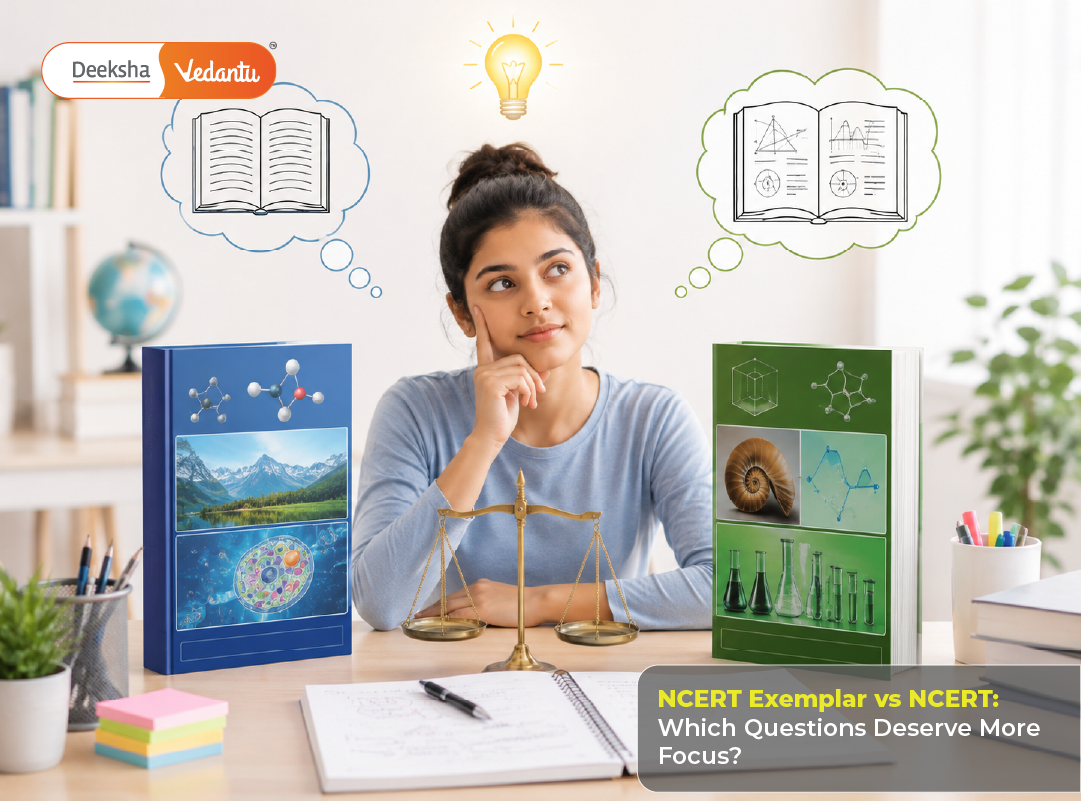

The repeater’s dilemma: You’ve already read NCERT twice. Now you see NCERT Exemplar sitting on the shelf. Should you invest 40-60 hours into it, or focus on something else?
The answer depends on one critical fact: Only 5-10% of NEET questions come directly from NCERT Exemplar. But 85%+ come from NCERT itself (direct or paraphrased).
Here’s the exact breakdown of where to focus your remaining time.
The Question Source Analysis: Where NEET Actually Pulls From
Based on analysis of NEET 2022-2025 papers:
NCERT Body Text (Direct/Paraphrased): 55-65%
- Example: “Write the chemical formula for ethanol” > Direct NCERT line
- These appear nearly identical to textbook content
- Difficulty: Easy to moderate
- Time to solve: 30-60 seconds
NCERT Examples + Solved Problems: 15-20%
- Example: A numerical problem identical to NCERT worked example
- Slightly modified setups of textbook problems
- Difficulty: Moderate
- Time to solve: 90-120 seconds
NCERT Diagrams + Figure Labels: 10-15%
- Example: “Label the parts of the mitochondria” (pulled from NCERT diagram)
- Questions based on NCERT illustrations
- Difficulty: Easy to moderate
- Time to solve: 30-45 seconds
NCERT Footnotes + Marginal Notes: 5-10%
- Example: Exception statements that appear in smaller text
- “Boron doesn’t follow octet rule” (often in footnote)
- Difficulty: Moderate to hard
- Time to solve: 60-90 seconds
NCERT Exemplar + Beyond NCERT: 5-10%
- Example: Application questions requiring concept extension
- Questions requiring synthesis of multiple NCERT concepts
- Difficulty: Hard
- Time to solve: 120+ seconds
The insight: 85-95% of NEET comes directly from NCERT mastery. Only 5-15% requires Exemplar or beyond-NCERT thinking.
NCERT Exemplar: What It Actually Tests
Question Types in Exemplar:
- Multiple Choice with Advanced Options (30%)
- Example: Four options all seem correct; requires fine distinction
- NEET relevance: 40% (these distinctions appear in NEET)
- Time per question: 2-3 minutes
- Numerical Problems (25%)
- Example: Multi-step calculations with setup variations
- NEET relevance: 70% (NEET loves numerical variations)
- Time per question: 3-5 minutes
- Short Answer (20%)
- Example: “Explain why SN1 is preferred in this case”
- NEET relevance: 10% (NEET is MCQ-only)
- Time per question: 3-5 minutes (wasted for NEET format)
- Assertion-Reason Pairs (15%)
- Example: “Statement A is true, Statement B is false because…”
- NEET relevance: 90% (NEET uses A-R format extensively)
- Time per question: 2-3 minutes
- Application-Based (10%)
- Example: Real-world scenarios requiring concept application
- NEET relevance: 60% (appears in biology especially)
- Time per question: 3-4 minutes
The reality: 40-50% of Exemplar questions are poorly aligned with NEET’s MCQ format and heavy emphasis on direct recall.
The Time Investment Analysis
NCERT Mastery Path (What You MUST Do):
- Complete NCERT readings: 60 hours
- NCERT end-of-chapter problems: 40 hours
- NCERT diagram labeling + footnotes: 20 hours
- Total: 120 hours (mandatory)
- ROI: 85-95% of NEET marks
NCERT Exemplar Path (What’s Optional):
- Exemplar numerical problems: 30 hours
- Exemplar A-R pairs: 15 hours
- Exemplar short answers (skip for NEET): 0 hours
- Total: 45 hours (optional)
- ROI: 5-10% of NEET marks (maximum)
Alternative Use of 45 Hours:
- Mock tests: 45 hours (10 full-length mocks)
- ROI: 20-30% of NEET marks (higher impact)
The math: 45 hours of Exemplar might gain you 30-40 marks. 45 hours of mocks might gain you 80-120 marks through error learning and speed optimization.
Exemplar ROI is lower than mock testing ROI.
The Subject-Wise Breakdown: When Exemplar Helps
Physics:
- NCERT mastery: 70% of marks
- Exemplar value: Numerical variation practice (helps with speed)
- Verdict: 60% value if already weak in numericals. 20% value if accurate in NCERT problems.
Chemistry:
- NCERT mastery: 75% of marks
- Exemplar value: Organic mechanism variations, inorganic reaction twists
- Verdict: 60% value for Organic Chemistry. 30% value for Inorganic/Physical.
Biology:
- NCERT mastery: 95% of marks
- Exemplar value: Application questions (minimal)
- Verdict: 10% value. NCERT mastery alone gets you 280+ marks out of 360.
Honest assessment: Biology doesn’t need Exemplar. Physics gains moderate benefit. Chemistry gains moderate benefit (especially Organic).
The Decision Framework: Should YOU Use Exemplar?
USE Exemplar if:
✅ You’ve completed NCERT 2+ times
✅ You’re scoring 90%+ on NCERT end-of-chapter problems
✅ Your mock scores are 600+ (you need last 50 marks)
✅ You have 6+ months remaining
✅ You want speed optimization in numericals
✅ You’re targeting 650+ scores
SKIP Exemplar if:
❌ You’re still on NCERT read 1-2 (prioritize NCERT completion)
❌ You’re scoring <80% on NCERT end-of-chapter problems
❌ Your mock scores are below 550 (focus on fundamentals first)
❌ You have <3 months remaining (use mocks instead)
❌ You want time-efficient mark gains (mocks > Exemplar)
❌ You’re targeting 600 marks (NCERT + mocks suffices)
The Honest Assessment
NCERT Exemplar is designed for CBSE board exams + JEE, not specifically for NEET.
NEET rewards NCERT depth, not Exemplar breadth.
A student who reads NCERT three times + takes 10 mocks will outscore a student who reads NCERT once + completes all of Exemplar.
The 45-hour question is critical: Would those 45 hours in Exemplar or 45 hours in mock tests give you better ROI?
Answer: Mock tests. Always.
The Recommended Path (12 Months)
Months 1-4: Complete NCERT 2x + NCERT problems
Months 5-8: Take 40 full-length mocks + analyze errors
Months 9-10: Exemplar numerical practice IF you have time and weak areas remain
Months 11-12: 10-year previous papers + final revision
This sequence prioritizes NCERT mastery (85% of marks) > mock test learning (10% of marks) > Exemplar finesse (5% of marks).
NCERT Exemplar is the “nice-to-have,” not the “must-have” for NEET. Master NCERT completely. Take mocks obsessively. Use Exemplar only for the final 50-mark push if time permits. Don’t sacrifice NCERT depth or mock test analysis for Exemplar breadth.












Get Social