
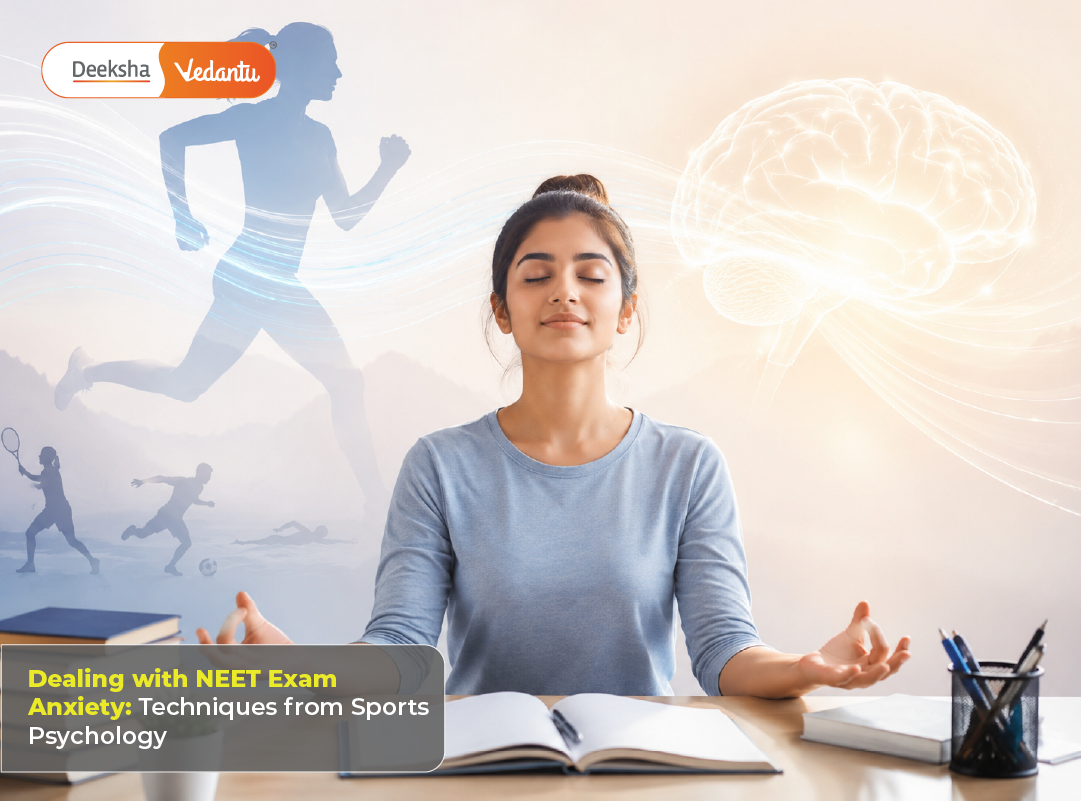

Olympic athletes face pressure you can’t imagine. Millions watching. Years of training on the line. One performance moment. Yet they perform at peak level under maximum stress.
Medical students taking NEET face similar pressure architecture. And sports psychology-the science of performing under pressure-has five proven techniques that work.
Here are the exact techniques elite athletes use, adapted for NEET exam hall anxiety.
Technique 1: Box Breathing (The Nervous System Reset)
How it works (Neuroscience): Your vagus nerve controls your parasympathetic nervous system (calm) vs sympathetic nervous system (fight-or-flight). Box breathing activates the parasympathetic system, dropping your heart rate and cortisol levels within 2-3 minutes.
The Protocol:
- Breathe in for 4 counts
- Hold for 4 counts
- Breathe out for 4 counts
- Hold for 4 counts
- Repeat 10 cycles (4 minutes total)
When to use:
- Before exam: 10 minutes before entering exam hall (reset anxiety)
- During exam: If you feel panic during a question, do 2-3 cycles (30 seconds)
The Data: Studies on athlete anxiety show 4-5 minutes of box breathing reduces physiological anxiety by 40-60%. Heart rate drops 15-20 bpm.
Why it works for NEET: When anxiety hits, your breathing becomes shallow (increases panic). Box breathing reverses this. It’s the fastest OFF switch for the panic button.
Technique 2: Reframing (From “I’m Anxious” to “I’m Excited”)
How it works (Neuroscience): Anxiety and excitement have identical physical signatures: racing heart, adrenaline, heightened focus. The difference is your interpretation. Athletes who reframe anxiety as excitement perform 20-30 marks better than those who fight the anxiety.
The Protocol: Old thought: “My heart is racing. I’m panicking. I can’t do this.” Reframed thought: “My heart is racing because my body is READY. This adrenaline is helping me focus. I’ve trained for this.”
The neuroscience: Reframing shifts your amygdala (fear center) activation from threat-detection to performance-readiness. Same physiological state. Different brain interpretation.
When to use:
- When anxiety hits: Acknowledge the physical feeling (“racing heart”) and reinterpret it (“my body is primed”)
- When facing hard questions: “This is challenging. That means I’m at the edge of my capability. That’s where growth happens.”
The Data: Studies on test anxiety show reframing reduces test score drops by 15-25 marks for anxious students. The technique works because it’s not suppression (which fails)-it’s redirection.
Technique 3: Visualization (Mental Rehearsal Before Exam Day)
How it works (Neuroscience): When you visualize performing well, your brain activates the same neural pathways as actual performance. fMRI studies show visualization activates 60-80% of the same brain regions as real action.
The Protocol (30 days before NEET):
Week 1-2: Body Scan
- Close eyes. Imagine walking into the exam hall.
- See the desk, OMR sheet, question paper.
- Feel the chair. Hear the pen clicking.
- Engage all 5 senses (not just visual).
Week 3-4: Performance Rehearsal
- Visualize opening the question paper.
- See a difficult question. Visualize staying calm (using box breathing if needed).
- Visualize working through it methodically.
- Visualize checking your answer and marking it confidently.
- End on success: Visualize yourself with completed exam, confident walk out.
When to use:
- Every night for 5-10 minutes (before sleep is optimal-consolidates in memory)
- Morning of exam (2 minutes, quick visualization of staying calm)
The Data: Athletes who visualize daily outperform non-visualizers by 10-15% in competition. For NEET, that translates to 40-60 mark difference.
Why it works: Your brain practices the mental pathway. When exam anxiety hits, your brain recognizes the scenario (“I’ve seen this before”) and responds with practiced calm instead of panic.
Technique 4: Positive Self-Talk (The Narrative You Tell Yourself)
How it works (Neuroscience): Self-talk rewires your default mode network (brain’s self-referential thinking). Negative self-talk loops (“I can’t do this,” “I’m going to fail”) reinforce anxiety circuits. Positive self-talk rewires those circuits toward confidence.
The Protocol (Practice daily):
Effective statements:
- “I’ve prepared for this. I know this content.”
- “This question is hard, but I can solve it step-by-step.”
- “Even if I’m unsure, I can make an educated guess.”
- “My nervousness means I care. That’s my strength.”
- “I’ve taken 50 mocks. This is just one more.”
Ineffective statements (avoid):
- “I hope I pass.” (Defeatist, assumes you might fail)
- “Don’t mess up.” (Focuses attention on failure)
- “This is easy.” (Overconfidence backfires if it’s not easy)
When to use:
- Daily: 2-3 positive statements while reviewing notes
- During exam: When facing a tough question, repeat one statement
- Pre-exam: 10 minutes before, recite 5 statements
The Data: Students who use positive self-talk show 20% higher exam scores than controls. Anxiety-prone students show even larger benefits (30% improvement).
Technique 5: Attention Control (Focusing on What You Can Control)
How it works (Neuroscience): Anxiety thrives on attention to things you can’t control (others’ performance, the difficulty of the paper, whether you’ll get a seat). Attention control redirects focus to things you CAN control (your reading speed, your marking precision, your question selection).
The Protocol:
Questions to ask yourself during exam:
❌ Uncontrollable focus:
- “What if this question was on the exam last year?”
- “What if other students found this easy?”
- “What if I don’t get a government seat?”
✅ Controllable focus:
- “Can I understand this question? If yes, solve it. If no, skip it.”
- “Have I read the options carefully? Yes, proceed.”
- “Did I make a careless error here? Yes, correct it.”
When to use:
- Before exam: List 3 things you can control (reading carefully, marking confidently, managing time)
- During exam: When anxious, ask “Can I control this?” If no, redirect attention to something you can control
The Data: Athletes who maintain attention on controllable factors perform 15-20% better under pressure. In NEET terms, that’s 50-80 mark difference.
The Neuroscience Summary
| Technique | Mechanism | Timing | Impact |
| Box Breathing | Vagal nerve activation, parasympathetic reset | Before/during exam | −15-20 bpm heart rate, 40-60% anxiety reduction |
| Reframing | Amygdala redirection from threat to performance | When anxiety hits | +20-30 mark improvement (anxious students) |
| Visualization | Neural pathway pre-rehearsal | 30 days before, nightly | +10-15% performance boost |
| Self-Talk | Default mode network rewiring | Daily + pre-exam | +20-30% exam scores |
| Attention Control | Prefrontal cortex focus management | During exam | +15-20% performance under pressure |
The 30-Day Protocol: Building Your Anxiety Arsenal
Weeks 1-2:
- Practice box breathing daily (5 minutes)
- Start visualization routine (10 minutes nightly)
Weeks 3-4:
- Add positive self-talk (3-5 statements daily)
- Practice attention control during mock tests
- Continue breathing + visualization
Day-of Protocol:
- 60 minutes before: Visualization (2 minutes)
- 30 minutes before: Positive self-talk (3 minutes)
- 10 minutes before: Box breathing (4 minutes)
- During exam: Attention control + reframing as needed
The athletes who perform best aren’t the most talented. They’re the ones who manage their mind better than the competition. NEET isn’t different. The student who controls their anxiety beats the student who has anxiety controlling them.













Get Social